How to Write Your Wedding Speech—Exercises for When You’re Completely Stuck
The hardest part of writing a wedding speech isn't writing—it's knowing how to start. These five exercises will help you get unstuck.
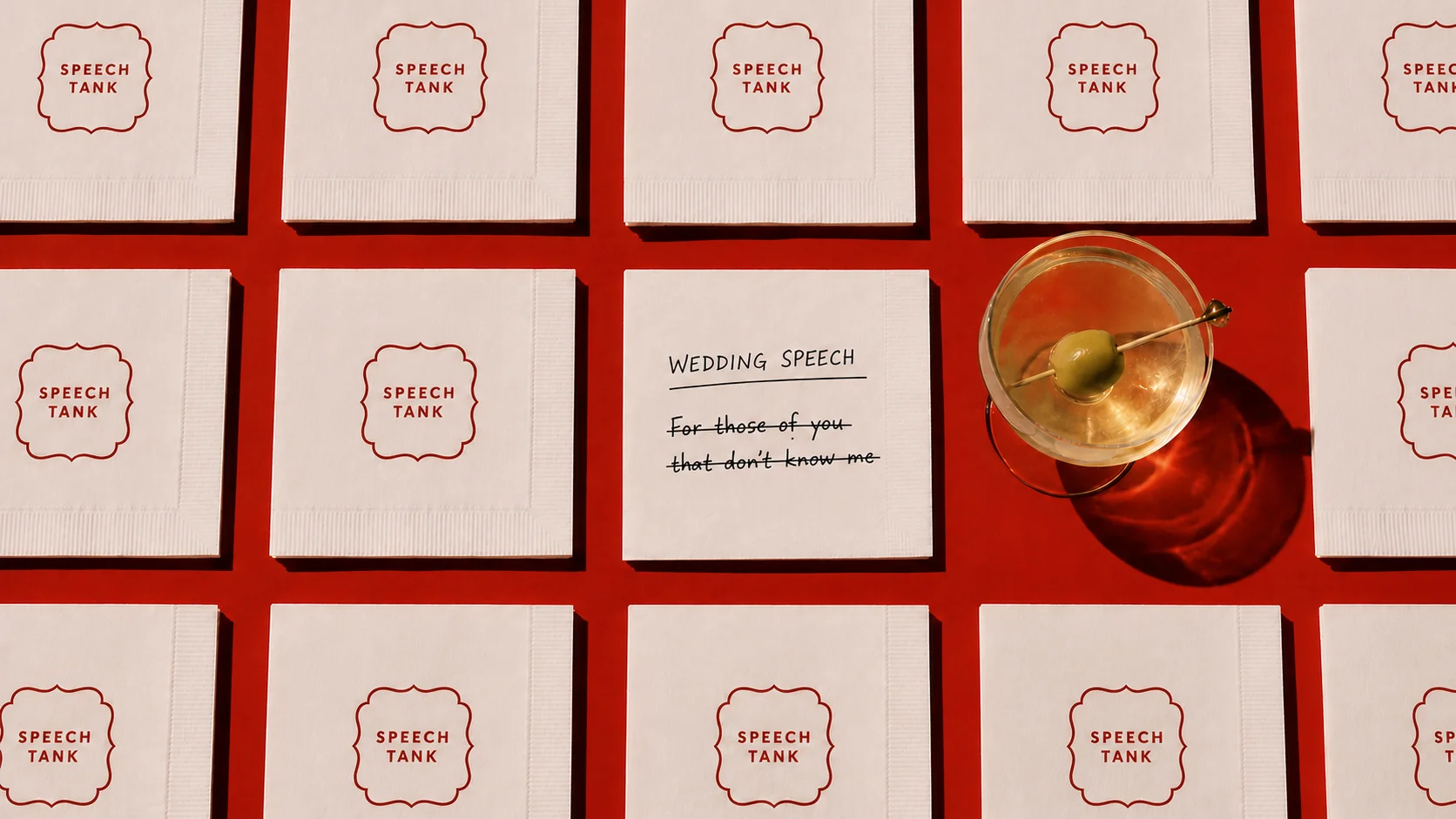
You’ve been “asked” by people close to you to give a wedding speech.
But after opening a blank Google Doc to stare at a blinking cursor for twenty minutes, then typing three sentences and promptly deleting all three, you're wondering if you actually know them at all.
We promise: you do—and you don’t have amnesia.
It can be tough to call to mind the memories that really show who a person is—harder still when that person has been in your life forever. But after writing wedding speeches for a decade, we've learned that getting stuck usually isn't a writing problem. It's a thinking problem.
So here are five exercises to unblock your thinker’s block:
Exercise 1: Brain Dump
The biggest mistake people make is trying to edit while writing. So first, let’s not write at all.
Open a totally new page (bonus points if it’s inside a notebook) and set a timer for ten minutes. Then, think about the person who asked you to speak. Jot down every memory, image, or random association that comes to mind. Don't worry about whether it makes sense or is “good enough” to say in front of a crowd.
Your job now is just to reminisce. In the end, your list may look something like this:
- Cross-country star as a freshman
- Pink hair phase
- Last-minute trip to Barcelona
- Map obsession
- Visiting her in seven cities
- The world's worst parallel parker
Then, set the timer again and set your mind on the couple.
Maybe the list becomes:
- The “I love you” mix-up
- Priya and Noah’s six-hour first date
- Priya beating him at trivia
- Buying their first house
- Noah helping her study for the LSAT
It's okay that most of these won't end up in your speech because you’ve already achieved two things.
First, you've centered your mind on the people you're celebrating instead of the pressure of writing. Second, well…we’re getting to that.
Exercise 2: Fill in the Blanks
If ten-minute timers and loose associations didn’t work for you…not to fear!
Try using these thought starters to get started. Don't overthink them. Just jot down the first thing that comes to mind.
What's the most Priya thing Priya ever did?
At breakfast, Priya decided she wanted to see the Northern Lights. By midnight, she was on a plane to Iceland.
When I met Priya, she was…
Rolling her eyes and convincing me she knew every kid in our ninth-grade class. There were 400 of them.
Something I'll never forget about Priya is the time…
She made a five-day Seattle itinerary packed with the most insanely fun things anyone has ever done. Later, I saw the itinerary in her notes app—the title: “Mission: Get Zoe to Move.”
The first time I thought Noah may be the right guy was…
Priya signed up for cooking lessons because she actually wanted to spend more nights at home.
I knew they were forever when…
They bought a house and a 90-pound dog that is too big to fit on airplanes.
Exercise 3: Say It Out Loud
If the desk chair isn’t helping with a breakthrough, head outside. See what inspiration strikes as you walk through the great outdoors.
Maybe the park evokes images of laser tag. Or the pizza joint reminds you of beloved late-night dance parties.
Press record on a voice memo and just talk about whatever comes to mind. Your first sentence can be something as simple as: “Okay…let me tell you about Priya.” Then keep talking. Go off on tangents. Repeat yourself. Laugh at your own memories.
When you're finished, transcribe the memo—and just like that, your blank page is fuller.
Exercise 4: Call Someone Who Knows Your Stories
Okay, none of that worked and you need to phone a friend.
Call a friend you've shared stories with—since they know fewer stories, it's possible they'll remember what you don't.
Maybe your mom says, “Remember when Priya somehow studied abroad her freshman year?”
Or your best friend tells you, “Every story you’ve ever told me about Priya starts with, ‘So she had this crazy idea…’”
The stories we tell over and over are rarely random. They’re the ones that made us laugh the hardest, taught us something, or perfectly capture who someone is. In other words, they’re often the perfect stories for a wedding speech.
Exercise 5: Find the Common Thread
By now, you may have pages of notes, half-finished sentences, voice memo transcripts, and story ideas. Now it's time to step back. Ask yourself:
What do all of these notes have in common?
- Cross-country runner
- Seven cities
- Study abroad
- House
- Law school
- Giant dog
Some stories in your list will inevitably point toward a bigger idea—a theme. Many stories show that before Noah, Priya had wanderlust. After she met him, she wanted to plant roots.
Maybe written, that becomes:
Our whole lives, I watched Priya chase something—and usually get it.
But seeing her tonight, it’s clear: Priya was never really searching for something—she was searching for someone.
And that someone could only ever have been Noah.
Without a theme, your speech is just a collection of funny memories. But with it, those same memories become evidence you can build on.
Every unforgettable wedding speech starts exactly the same way: with a blank page. The difference isn't that great speakers have better stories—it's that they know how to find them. Now, you do too.
Quick FAQs
How long should a wedding speech be?
Three to five minutes is the sweet spot, or about 600–750 words. Leave them wanting more.
Is it okay to use notes during a wedding speech?
Absolutely. Your audience isn't grading your memory. Practice enough that you know the flow of your speech and can deliver it naturally, but bring a printed copy just in case. It’s easier to glance at than to scroll through your phone.
Can I tell embarrassing stories in a wedding speech?
Truly embarrassing? Absolutely not. The best stories offer the audience a new window into the couple—they don't make that couple cringe. If you're unsure whether a story crosses the line, leave it out.
What if I get emotional during my wedding speech?
You should! Being asked to talk on someone’s most important day is an emotional thing. If you need a moment, pause, take a breath or a sip of water, and continue. And remember, everyone up there is rooting for you.
Ready to write yours?
Speech Tank turns your memories into a polished wedding speech in minutes.